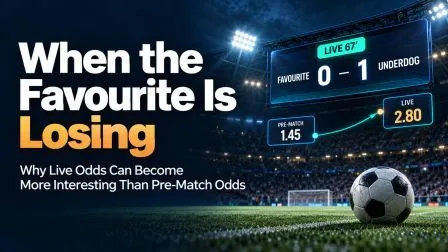
A strong football favourite goes 1–0 down after 18 minutes. What happened to the pre-match prediction? Not much, and everything.
The favourite is still the same team. Same players, same coach, same underlying quality. But the match has entered a completely different mathematical universe. There are 72 minutes left, the opponent can defend deeper, tactics change and every minute without an equaliser makes the original expectation slightly less useful.
This is why live odds can be fascinating. Pre-match odds describe what might happen before anything has happened. Live odds have to digest what is actually happening, continuously.
The clock suddenly becomes a statistic
Suppose your favorite team has a 70% chance of winning before the game, what is the probability of it winning? Then it concedes.
Being 1–0 down after five minutes is obviously not the same as being 1–0 down after 85. The score is the same but the opportunity to improve is totally different.
Time becomes then almost an invisible player.
The last few minutes of football have been fascinating in this match. In 2025-26, 16.5% of Premier League games ended in second-half stoppage time goals that changed the outcome of the match, Opta reveals. It was 6.7% for the entire history of the Premier League.
This is a change that has been coming for a while now, which has been aided by the passing of time. Since 2006-07, the last ten goals scored by Opta have been from the 2023-24 season onwards.
Now 90:00 doesn’t have the same connotation it once did. Football has secretly developed the 100+ minute game without changing the name.
A goal changes more than the score
If this is the case, the underdog scores first first and the live calculation cannot just take something off the favourite’s pre-match probability.
The goal changes behaviour.
The trailing favourite may push its full-backs higher, press more aggressively and take additional risks. The underdog may retreat, slow the match and concentrate on transitions. Suddenly the match generating the data is structurally different from the match everyone expected at kick-off.
Opta has demonstrated how significant this “game state” effect can be. Teams that are behind tend to have a greater need to attack, meaning even statistics such as shots and expected goals have to be interpreted within the scoreline.
This creates the fun paradox of live football: the favourite can become less likely to win according to the scoreboard while simultaneously becoming more dominant on the pitch.
Possession can help — but don’t fall in love with it
Suppose our losing favourite now has 68% possession. Interesting? Yes. Proof that an equaliser is coming? Absolutely not.
Possession without dangerous progression can simply mean watching centre-backs pass to each other very beautifully.
More sophisticated models therefore examine what teams actually do with the ball. Stats Perform’s Possession Value framework, for example, estimates the probability that the team controlling the ball will score within the next 10 seconds.
That distinction matters enormously. Ten harmless passes near the halfway line and one through-ball sending a striker behind the defence are both “possession”. They clearly don’t carry the same attacking information.
This is what makes an in-play match so different from checking prices prior to kick-off, for those that follow the markets on the likes of 22Bets. So now the question is, is the match that is happening the match that everyone was looking for?
Is the past with probabilities like the amnesiac?
Another thing that people can’t always keep in their heads, when watching live models, is a tremendous amount of history.
If a team is losing, what is the average frequency of the team’s score? What’s the productivity of matches in the last 15 minutes? How does it work when substitutions are called for? How many goals does it take to make up for one goal in a game?
Consider substitutes. During the 2023-24 Premier League, 39.4% of late goals (in the third term of games) were scored using substitutes compared to 24.6%. After 22 matches, however, the amount of goals at the end of 75 minutes increased to 44.9% through substitutions in 2024-25.
The “1–0” in minute 65 has a lot more meaning than “1–0”. The manner of the absence of a player on the bench counts. So does fatigue, targeting pressure, cards, shape and quality of chances already created.
In football history there’s plenty of examples that demonstrate that any prediction made in the pre-match has an expiry date.
Argentina combined to open their World Cup campaign as one of the tournament favourites, and even took the lead from Lionel Messi in the opening game against Saudi Arabia. Saudi Arabia doubled-up after the break and extended their lead to 2-1. Liverpool had an even more ludicrous performance in 2019, as they went 3–0 up against Barcelona, but came back to level with the 4–0 victory at Anfield in the Champions League.
These were extraordinary matches, not only because the script was continually being rewritten, but because of that.
Live odds are a moving story
That is ultimately the attraction of live probability.
Pre-match pricing asks: *What should happen?*
Live pricing asks a much more entertaining question: *Given everything we believed before kick-off, plus everything we have just seen, what should happen now?*
Then a goal arrives. Recalculate.
A red card. Recalculate.
Ten minutes disappear. Recalculate.
The favourite suddenly produces three dangerous chances. Recalculate again.
Football remains gloriously stubborn about obeying probability, of course. A 70% chance is never a promise. But live odds reveal something fascinating underneath the chaos: every pass, goal and disappearing minute is continuously changing the future.
The scoreboard may only move occasionally. The probabilities never stop.